Showing posts with label OUCS205. Show all posts

Sunday, 25 March 2012

Task 5 - The Gaze

‘According to usage and conventions which are at last being questioned but have by no means been overcome - men act and women appear. Men look at women. Women watch themselves being looked at’ (Berger 1972, 45, 47)
Discuss this quote with reference to one work of art and one work from the contemporary media.


Berger writes about how the gaze and how it is about being watched and being aware of yourself; how men look at survey women before they determine how to treat them and because of this women had to make sure they were seen in a way they want to be appear. He talks about how men and women have a different social presence in society, men are seen as more powerful and dominant to women, whereas women are to be looked at by men. Women turn themselves into object in order for me to 'gaze' at them and see them in a certain way. Furthermore women should express themselves through how they look; their tastes, their surrounds and what they wear. Women should be aware of them being watched and hence be aware of how they are seen. "An so she comes to consider the surveyor and the surveyed within her as the two constituent yet always distinct elements of her identity as a women."


‘Birth of Venus’ - Alexandre Cabanel’ (1863)

This painting is a good example of the gaze and how women have been percieved. The figure takes up two thirds of the whole composition and she depicted in a slightly seductive, reclining position where showing off the female form. While one arm is stretched behind her, the right partially covers her eyes; she is not looking directly at the viewer, removing the 'intimacy' of her gaze and allowing us to look at an objectify her without her seeing or knowing. 'To be on display is to have the surface of one's own skin, the hairs on one's own body, turned into a disguise, which, in that situation, can never be discarded. The huge is condemned to never be naked. Nudity is a form of dress." Many art pieces  were created for a male dominated audience, this quote talks about how nudity is now a form of dress; therefore making it socially acceptable for men to gaze and naked / nude paintings of women. 


Sophia Dahl, Yves Saint Laurent advert,

The photograph on the left was the original orientation but changed to the portrait orientation for the actual advert as the original was too suggestive. This advert has been banned in the UK after receiving 730 complained and deemed 'offensive and degrading.', The original horizontal orientation was not allowed to be used because of the suggestive sexual nature of the female form, and hence not suitable to be placed in public. Just like the 'Birth of Venus', the figure of Sophia Dalh is not looking at the viewer, allowing us (male dominated society) to look at the picture and objectify her. However, it is the suggestive and erotic post of the female form that invites men to objectify this, a women using her sexuality to attract public attention. This is something that has become very accepted in our society today from films, posters to even music video where female artists are wearing very little and dancing in a seductive manner; exploiting their sexuality to gain attention, sell records and hence become a success. It could be argued that this painting is no less suggestive or artistic than a classic painting of a female nude; another reason why the photograph was turned so that she was not lying on her back in that position; an attempt to be slightly less seductive. 


QUOTES FROM 'WAYS OF SEEING'


MAIN POINTS


he examins the ideas by looking at nude images of women - women carry around the idea that they are being looked at


KEY QUOTES


Writing in 1972, Berger insisted that women were still ‘depicted in a different way to men - because the "ideal" spectator is always assumed to be male and the image of the woman is designed to flatter him’


‘it could be argued that when women look at these ads, they are actually seeing themselves as a man might see them’ (Messaris 1997, 41).


So the women who look at these ads are being invited to identify both with the person being viewed and with an implicit, opposite-sex viewer’


Sources


http://www.aber.ac.uk/media/Documents/gaze/gaze08.html


http://www.arts.cornell.edu/histart/DOCS/ways_of_seeing_CH3.pdf


http://news.bbc.co.uk/1/hi/talking_point/1077818.stm

Task 4 - Hyperreality

Write a short analysis (300 words approx.) of an aspect of our culture that is in some way Hyperreal. Hyperreality is an awqard and slippery concept. 


TASK


Hyperreality is where something has been replaced by a simulacrum; a representation of something that is real.
I feel that this quote is a good example of the world that we live in today; everything we see is the 'better' version of the original, people are never interested in the natural look, instead they strive for the illusion of perfection.
Baudrillard has written that he think the division between real and simulation has collapsed, and we now live in a hype-real world, everything we see has been edited, enhanced, cut or super imposed and that 'image is everything' to us today, as a result we produce 'perfect' replicas or versions of ourselves and our world. "The very definition of the real has become: that of which it is possible to give an equivalent reproduction. . . The real is not only what can be reproduced, but that which is always already reproduced: that is the hyperreal. . . which is entirely in simulation. Illusion is no longer possible, because the real is no longer possible."  An example of hyperreality is the images that are released and used in the media, mainly in the fashion and gossip magazines. Photographs are taken of celebrities and models and are then edited and enhanced using Photoshops (and other programs) so to create an image of perfection. The image of what beauty should be, which is then used by the media knowing that people will attempt to copy it. This topic reminds me of a few photographs that Britney Spears released a few years ago to show to the world how touched up and fake the images in magazines actually were. As you can see she has been slimmed town, airbrushed, removed the imperfections to show flawless skin, the cracks in her heals have been airbrushed out; all of this to produce and image that people over the world compare themselves to thinking it was an image of what the idea / perfect figure or woman should look like, when in reality they would be comparing themselves to a false representation of a woman, hence creating unhealthy role models as people strive for something that isn't real, shown through the quote below.


Definition


Hyperreality is used in semiotics and postmodern philosophy to describe a hypothetical inability of consciousness to distinguish reality from a simulation of reality, especially in technologically advanced post-modern societies. Hyperreality is a way of characterizing what our consciousness defines as "real" in a world where a multitude of media can radically shape and filter an original event or experience


hyperreality [ˌhaɪpərɪˈælɪtɪ]
n pl -ties
(Sociology) (Philosophy) an image or simulation, or an aggregate of images and simulations, that either distorts the reality it purports to depict or does not in fact depict anything with a real existence at all, but which nonetheless comes to constitute reality


Simulacrum (pluralsimulacra), from the Latin simulacrum which means "likeness, similarity",[1] was first recorded in the English language in the late 16th century, used to describe a representation, such as a statue or a painting, especially of a god


hyperreality:-a condition in which "reality" has been replaced by simulacra


ABOUT HYPERREALITY


Most aspects of hyperreality can be thought of as "reality by proxy." Some examples are simpler: the McDonald's "M" arches allegedly make the material promise of endless amounts of identical food from the store, when in "reality" the "M" represents nothing, and the food produced is neither identical nor infinite, as a person would expect from a fast food restaurant


KEY QUOTES


Jean Baudrillard (1994) maps the transformation from representation to simulacrum in four ‘successive phases of the image’ in which the last is that "it has no relation to any reality whatsoever: it is its own pure simulacrum" 


One of the fundamental qualities of hyperreality is the implosion of Ferdinand Saussure’s (1959) model for the sign (see semiotics) (pg. 67). The mass simulacrum of signs become meaningless, functioning as groundless, hollow indicators that self-replicate in endless reproduction. Saussure outlines the nature of the sign as the signified (a concept of the real) and the signifier (a sound-image). Baudrillard (1981) claims the Saussurian model is made arbitrary by the advent of hyperreality wherein the two poles of the signified and signifier implode in upon eachother destroying meaning, causing all signs to be unhinged and point back to a non-existing reality (180). Another basic characteristic of the hyperreal is the dislocation of object materiality and concrete spatial relations (seeobjecthood). 


SOURCES


http://www.vanderbilt.edu/AnS/Anthro/Anth206/jean_baudrillard_and_hyperrealit.htm


http://138.232.99.40/RSim061108_Sim_Sim.pdf

http://csmt.uchicago.edu/glossary2004/realityhyperreality.htm

http://mediacrit.wetpaint.com/page/Hyperreality%3A+The+Authentic+Fake


Task 2 - Benjamin & Mechanical Reproduction

Read the Walter Benjamin's essay 'The Work of Art in the Age of Mechanical Reproduction'. Write a 300 word analysis of one work of Graphic Design, that you think relates to the themes of the text, and employing quotes, concepts and terminology from the text.

The essay can be found online here.


http://www.marxists.org/reference/subject/philosophy/works/ge/benjamin.htm

SUMMARY

Benjamin's essay talks about the Capitalist mode of the age of Mechanical reproduction "changes the reaction of the masses toward art" and how the principles of art have always had the capability to be reproduced, and this change in and reproduction created a "whole new appreciation of art is introduced while at the same time a whole new mode of deception and distraction."  The Marxist theory shows how the reproduction of art creates a loss in the value and understanding of the art, hence creating a revolutionary type of art and the loss of its 'aura.' The message and meaning of the original artwork is lost through the process of reproduction. The mechanical reproductions are showing people how to see rather than letting people interpret and see what they do from their own will for example in a gallery the painting where a painting would have an interpretation written next to it. "The presence of the original is the prerequisite to the concept of authenticity." He talks about how original pieces of art have a sense of tradition and authority, they are more special because of their uniqueness and the time, space and way that they were created, and through the mechanism of reproduction, this is lost as the prints are not original, they 

Today society has found ways to reproduce art more effectively however this has created the loss of aura; the uniqueness and meaning has been lost through its reproduction. This reproduction also made art more accessible, as the advances get easier, you can reproduce art easily e.g. lithography, photography, film which can now all be viewed on the internet rather than a gallery. "With lithography the technique of reproduction reached an essentially new stage. Lithography enabled graphic art to illustrate everyday life, and it began to keep pace with printing." It allows culture to come to the viewer rather than the viewer finding it in a gallery.

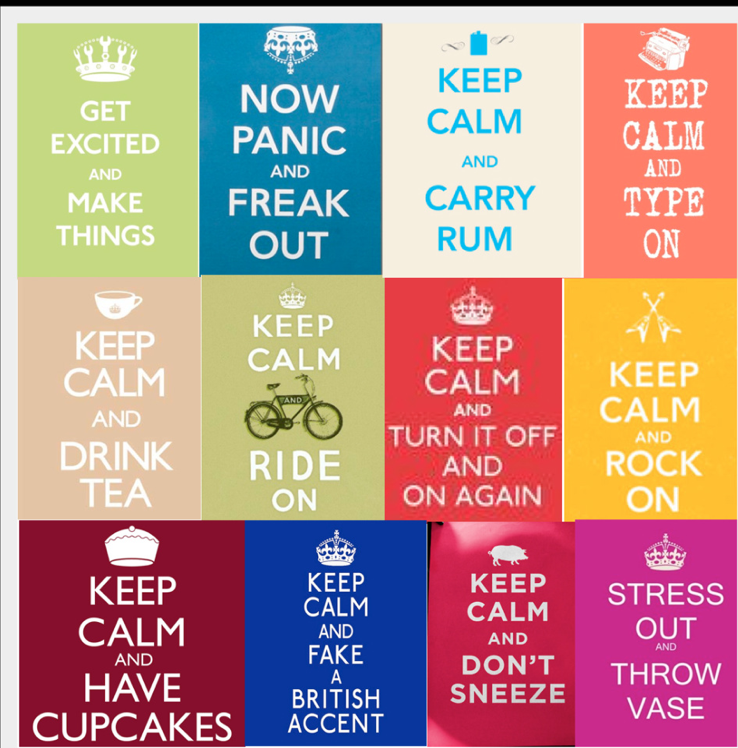
Today art is becoming less of an expression and more of a business idea, its is produced for the masses to make money rather than a personal expression. An example of this is the 'Keep Calm Carry On' poster which was origianlly created by the British Government as moral boosting propeganda posters in WW2. Although it was never indented to be a piece of art, today this poster has been reproduced, adapted and printed on various products that are now sold all over the UK. This poster used to be iconic because of the meaning, message and time. Now the print is iconic because of the large range of adaptations created and mass production of it.


KEY QUOTES

Mechanical reproduction of art changes the reaction of the masses toward art

The concepts which are introduced into the theory of art in what follows differ from the more familiar terms in that they are completely useless for the purposes of Fascism. They are, on the other hand, useful for the formulation of revolutionary demands in the politics of art


Clearly, this is at bottom the same ancient lament that the masses seek distraction whereas art demands concentration from the spectator


In principle a work of art has always been reproducible. Man-made artifacts could always be imitated by men.


Mechanical reproduction of a work of art, however, represents something new.


"With lithography the technique of reproduction reached an essentially new stage. Lithography enabled graphic art to illustrate everyday life, and it began to keep pace with printing." ew decades after its invention, lithography was surpassed by photography


Friday, 23 March 2012

Outline of Panoptisism, Sparknotes summary


http://www.sparknotes.com/philosophy/disciplinepunish/section7.rhtml


Panopticism

Summary


Foucault begins with a description of measures to be taken against the plague in the seventeenth century: partitioning of space and closing off houses, constant inspection and registration. Processes of quarantine and purification operate. The plague is met by order. Lepers were also separated from society, but the aim behind this was to create a pure community. The plague measures aim at a disciplined community. The plague stands as an image against which the idea of discipline was created. The existence of a whole set of techniques and institutions for measuring and supervising abnormal beings brings into play the disciplinary mechanisms created by the fear of the plague. All modern mechanisms for controlling abnormal individuals derive from these.
Foucault then discusses Jeremy Bentham's Panopticon, a building with a tower at the center from which it is possible to see each cell in which a prisoner or schoolboy is incarcerated. Visibility is a trap. Each individual is seen but cannot communicate with the warders or other prisoners. The crowd is abolished. The panopticon induces a sense of permanent visibility that ensures the functioning of power. Bentham decreed that power should be visible yet unverifiable. The prisoner can always see the tower but never knows from where he is being observed.
The possibility that the panopticon is based on the royal menagerie at Versailles is raised. The Panopticon allows on to do the work of a naturalist: drawing up tables and taxonomies. It is also a laboratory of power, in which experiments are carried out on prisoners and staff. The plague-stricken town and the panopticon represent transformations of the disciplinary programme. The first case is an exceptional situation, where power is mobilized against an extraordinary evil. The second is a generalized model of human functioning, a way of defining power relations in everyday life. The Panopticon is not a dream building, but a diagram of power reduced to its ideal form. It perfects the operations of power by increasing the number of people who can be controlled, and decreasing the number needed to operate it. It gives power over people's minds through architecture. As it can be inspected from outside, there is no danger of tyranny.
The panopticon was destined to spread throughout society. It makes power more economic and effective. It does this to develop the economy, spread education and improve public morality, not to save society. The panopticon represents the subordination of bodies that increases the utility of power while dispensing with the need for a prince. Bentham develops the idea that disciplines could be dispersed throughout society. He provides a formula for the functioning of a society that is penetrated by disciplinary mechanisms. There are two images of discipline: one) the discipline blockade—an exceptional enclosed space on the edge of society; and two) the discipline-mechanism—a functional mechanism to make power operate more efficiently.
The move from one to the other represents the formation in the seventeenth and eighteenth century of a disciplinary society. Other increasingly profound processes operated: one) the functional inversion of disciplines; two) the swarming of disciplinary mechanisms; mechanisms begin to circulate openly in society, and are broken down into flexible methods of control; three) the state control of discipline, as in the formation of a central police power.
We can talk of the formation of a disciplinary society in the movement from enclosed disciplines to an infinitely extendible "panopticism". The formation of a disciplinary society is connected to several historical processes: one) disciplines are techniques of assuring the ordering of human masses that elaborate tactics of power that operate economically and invisibly. These tactics aim to increase the docility and utility of all elements of the system. This corresponds to a population increase, and a rise in the numbers to be supervised. The development of a capitalist economy led to a situation where these techniques could be operated in diverse regimes. Two) the panoptic modality of power is not independent. The disciplines and panopticism are the reverse of a process by which rights are guaranteed. The Enlightenment, which invented the liberties, also invented the disciplines. Three) what is new in the eighteenth century is the combination of disciplinary techniques. This occurred within a development of other technologies. The eighteenth century invented the examination, just as the middle-ages invented the judicial inquisition; much of modern penal techniques reveal the penetration of the examination into the inquisition.
The extreme of ancien regime penality was the dismemberment of the convict's body: the ideal position of modern penality is the indefinite examination. It is no surprise that the cellular, observational prison is the modern penal instrument, or that prisons resemble factories, schools and hospitals.

Analysis

In many ways, this is the heart of the book. For Foucault, the panopticon represents the way in which discipline and punishment work in modern society. It is a diagram of power in action because by looking at a plan of the panopticon, one realizes how the processes of observation and examination operate.
The panopticon is introduced through a contrast, a typical Foucault device (think of the contrast between the execution and the timetable). The plague is an interesting case, however. Firstly, Foucault examines a text about plague measures, rather than an account of an actual plague. To him, this is unimportant because texts and reality interact closely. One might ask why the plague acted as an image against which the mechanisms of discipline were defined. It was not because the plague represents a loss of order: the restoration of order was the aim of rituals such as the public execution. Rather, it was because when plague strikes, the boundaries of normal and abnormal are blurred. Anyone can become sick, and therefore abnormal; and what is abnormal is particularly dangerous in this case.
In focusing on the panopticon, Foucault adopts it as a symbol of his whole argument. The theory of discipline in which everyone is observed and analyzed is embodied in a building that makes these operations easy to perform. The panopticon develops out of the need for surveillance shown in the plague. Plague measures were needed to protect society: the panopticon allows power to operate efficiently. It is a functional, permanent structure. The transition from one to another represents the move to a society in which discipline is based on observation and examination. The disciplinary society is not necessarily one with a panopticon in every street: it is one where the state controls such methods of coercion and operates them throughout society. The development of a disciplinary society involves socio-economic factors, particularly population increase and economic development.
Foucault argues that more sophisticated societies offer greater opportunities for control and observation. This explains the reference to liberty and rights. Foucault assumes that modern society is based on the idea that all citizens are free and entitled to make certain demands on the state: this ideology developed in the eighteenth century, along with the techniques of control he describes. Foucault is not against such political ideals: he merely argues that they cannot be understood without the mechanisms that also control and examine the citizen. This examination spreads throughout society. Schools, factories, hospitals and prisons resemble each other, not just because they look similar, but because they examine pupils, workers, patients and prisoners, classify them as individuals and try to make them conform to the "norm". The fact that the modern citizen spends much of his life in at least some of these institutions reveals how far society has changed.

A basic outline of Panopticism


Panopticism in Foucault's Discipline and Punish

In Discipline and Punish, Michel Foucault builds on Jeremy Bentham's conceptualization of a panopticon as he elaborates upon the function of disciplinary mechanisms in the prison and illustrates the function of discipline as an apparatus of power. The "panoptic" style of architecture may be used in other institutions with surveillance needs, such as schools, factories or hospitals. The ever-visible inmate, Foucault suggests, is always “the object of information, never a subject in communication.”.[1] He adds that,
"He who is subjected to a field of visibility, and who knows it, assumes responsibility for the constraints of power; he makes them play spontaneously upon himself; he inscribes in himself the power relation in which he simultaneously plays both roles; he becomes the principle of his own subjection" (202-203).[2]
Foucault offers still another explanation for the type of "anonymous power" held by the operator of the central tower, suggesting that, "We have seen that anyone may come and exercise in the central tower the functions of surveillance, and that this being the case, he can gain a clear idea of the way the surveillance is practiced."[3] By including the anonymous "public servant," as part of the built-in "architecture" of surveillance, the disciplinary mechanism of observation is decentered and its efficacy improved.
As hinted at by the architecture, this panoptic design can be used for any "population" that needs to be kept under observation or control, such as: prisoners, schoolchildren, medical patients or workers:
“If the inmates are convicts, there is no danger of a plot, an attempt at collective escape, the planning of new crimes for the future, bad reciprocal influences; if they are patients, there is no danger of contagion; if they are madmen there is no risk of their committing violence upon one another; if they are schoolchildren, there is no copying, no noise, no chatter, no waste of time; if they are workers, there are no disorders, no theft, no coalitions, none of those distractions that slow down the rate of work, make it less perfect or cause accidents.”[1]
By individualizing the subjects and placing them in a state of constant visibility, the efficiency of the institution is maximized. Furthermore, it guarantees the function of power, even when there is no one actually asserting it. It is in this respect that the Panopticon functions automatically. Foucault goes on to explain that this design is also applicable for a laboratory. Its mechanisms of individualization and observation give it the capacity to run many experiments simultaneously. These qualities also give an authoritative figure the “ability to penetrate men’s behavior”[1] without difficulty. This is all made possible through the ingenuity of the geometric architecture. In light of this fact Foucault compares jails, schools and factories in their structural similarities.

[

Panopticism research

These are a couple of paragraphs about Panoptisism taken from 'The Panoptic Sort; a political economy of personal information - Oscar H. Gandy


Sunday, 18 March 2012

Task 1 - Panopticism

Choose an example of one aspect of contemporary culture that is, in your opinion, panoptic. Write an explanation of this, in approximately 200-300 words, employing key Foucauldian language, such as 'Docile Bodies' or 'self-regulation, and using not less than 5 quotes from the text 'Panopticism' in Thomas, J. (2000) 'Reading Images', NY, Palgrave McMillan.


Panoptisism is derived from the design and creation of the Panopticon; a circular building that was designed to be  "a new mode of obtaining power of mind over mind, in a quantity hitherto without example." This power was obtained by the circular layout where the individual cells could be observed by a central tower, where the inmates would not be able to see or communicate with each other and believed themselves to be under constant surveillance hence making the inmates self monitor and self-correct themselves. The idea of panopticon was the start of the transition from obtaining power by force to obtaining power by mind. 'The power relations have immediate hold upon it (the body) they invest it, mark it, train it, torture it, force it to carry out tasks, to perform ceremonies, to emit signs

FOCAULT 1975


Panoptisim is a part of our everyday lives in Western society, to create 'docile bodies;' self monitoring, self-correcting, obedient and productive people. The idea that "the useful object will no longer be the body of the guilty man set up against the body of the king...it will be the disciplinary individual" Meaning that instead of a person being physically faced with power, the power is instead obtained though a mental state of fear of constantly being watched, and that the fear of them being caught out will over power them resulting in a person to act in a way that they believe society wants or expects them to act. 

CCTV is a an example of contemporary culture that is Panoptic, the "function is to assure that discipline reigns over society as a whole"where 'visibility is a trap". Its main aim is to reduce crime and increase efficiency and productivity of a person through the fear of being watched. There are now 4.2 million cameras in the UK (1 camera to every 14 people). Thus meaning that much of our every day movement is being watched. The idea that if you can see a camera, you will not act out and instead conform to the way society expects a person to act, inducing self-regulated behaviour (docile bodies);  "To induce the inmate state of conscious and permanent visibility that assures the automatic functioning of power." Furthermore "the prisoner should be constantly observes by inspector...what matters is that he knows himself to be observed". This shows that 'docile bodies' are most effectively obtained if the person knows that they are being constantly being watched; like CCTV. "Our society is one not of spectacle, but of surveillance; under the surface of images, one invests bodies in depth; behind the great abstraction of exchange , there continues the meticulous, concrete training of useful forces; the circuits of communication are the supports of an accumulation and a centralisation of knowledge". The Panoptic idea of CCVT is also used to monitor and examine our behaviours as well as to enforce the power over a society where the "function is to assure that discipline reigns over society as a whole". Foucault also talks about how 'where there is power there is resistance', however with CCVT there is no physical body to resist with (like a boss or teacher), instead the power is harder to defy because it is in some part invisible.


Sources;


Thursday, 23 February 2012

Lecture 11- The Production and Critique of Institutions

AIMS

to examine the historical development of practices of institutional criquite in relation the corresponding development of the modern art gallery.

OBJECTIVES

  • to demonstrate the importance of the art museum to raise the bourgeois publish sphere in the 19th century
  • to analyse peter Burges theorisation of the twin development of aestheticism (formalist) art practice, and critical avant-gardism in the first three decades of the 20th century. 
  • to consider the postwar critique of the convention of the white cube through attention to Brian O'Doherty's Inside the White Cube, and Michael Asher's 1974 Claire Copley Gallery installation. 
MARIXISM

idealogoy = false conciousness, ideology explains mans failure to comprehend....

Different class interests - have their own take on our place in wider society

TJ clark - idealogys are systems of belive, tequniques of representation, social classes in conflict with one another, attempting to naturalise their own special place in natural history

Our life circumstances are routed by our material situation - social constructed by lots of different voices that emerge from their own material circumstances

You are constatnly coming into contact with other opposing belif systems. The daily activity of getting up and going to work you get in contact with these

POST REV FRANCE - end of 18th century

Louvre 
Example of production of ideology belifs if post revolutionary France - designed to promote the core values that was the new French State - rise of Bourgois. 
Clammer to create spaces devoted to celebrate mans greatest feets - those that matched the new; liberty, cority, fraternity

Liberty Leading the People - 

Opening the Louvre - politician said that it woudl quiet the political storm and get good for both them and their enemies

IDEOLOGICAL ASSUMTIONS

Woman are caring
Men are strong

These are the what Barthe terms the 'falsly obviou's and potentially routed in prejudice


Thursday, 2 February 2012

Concensorship and truth

OVER VIEW

  • notations of censorship and truth
  • the indecical qualities of photographys in rendering truth
  • photographic manipulation and the documentation of truth
  • censorship in advertising
  • censorship in art and photography. 
PHOTOGRAPHy - captutures a scene - but it can be made to lie either through the picture or through the photographer. 
There is more truth in something like this than a digital photo however manipulation is not new. 


Discussing - is this picture actually hurting anyone - this is an example of digital manipulation


Made her slimmer - today this is not news - but then this cauesd a scandal - notions of truth - is it actually affecting anyone. This picture is meant to be intising but it isnt actually hurting anyone

2 images put together to portray a truth. Various examples of something like this with war journalists. They are documenting the reality of something that is going on. This is the truth but some pictures have more manipulation etc to make it look more dramatic e.g. explosions. You can see in this photo that they is smoke from an explosion in the background. Is this less frivilous than the photo of kate winslet

During the Spanish civil war. Is this actually an authentic image of a man being shot in battle. Does it really matter if he is or isnt but more about what happens in war. He is wearing a scull cap thing - people thought that this was the exit of the bullet form his head but upon closer look it was just a protective hat. In the spannish war they take a siesta - agree not to shoot each other but one side weren't truthful and this was an image of the moment of attack. Is it enigmatic of death or is it actually death. 


This is one of the few images or reality from the war.


he wrote about how the war did happen - very graphic imagery, very disturbing but are these things that we should be shown so that we know what it is really like. With the gulf war - these things weren't being shown to the public - black and white - almost more arty - if you were to add colour would it add more realism to the photography. 


Shows a guy at the steering wheel of truch at the time he was fire bombed. This picture did make it to the media - but people still thought that it was too graphic - also because it was taken in colour - does it make it more real. What does it say about us a public if we cant see these things - our taxes are going to the war - should we be shown what our money is being put towards. 
He taks about how people have a right to see them - but in reality do we actually want to be shown them


An extract from the book 

Fine art phtoographer who is documenting these war events. 


Is this the aircraft carriers experience of reaily. Is this what we should be seeing as news or is this more about the grim reality os what goes on. 

obscene / objectory
What is our morla code as society and what we accept when we see it. 


If one person looks at an advert and thinks one thing and one person says another - where do we stand - is it indicative of that persons thought

If one person is thinking of what it represents or is much ore - and will this be a problem. This isnt just an issue that you see advertising. 

Adverts that have aimed to show - in their own way these images have become iconic. 
The child's picture - the angel faces white girl and the devil horned black girl - looks at the issue of race and sexuality. 


14 year old girl on the cover of an album - now this wouldn't have been accepted. Her mother tried to stop it. You wouldn't have been able to tell that she was 14 by her physicque.


She takes photos of her own family. She is holding a candy cigarette but is it trying to provoke the image of a child acting as a young women

Is it depicting it so that they will be harmed - more sexualised. A slightly different exploitation of how you would photograph your own children - do the children have the right to say 


American phtoographer who produced this series of her children in masks. 
Charles saatchi brought them  - they were then placed in an exhibition - this is not normal of how naked photographs taken by parents are used. 


Reference to the gaze lecture
Could be a study directed at the gaze - but she doesnt have any formal phtographic training / experience. 


The gaze - the boy behind is staring at the child. 

where is the line between obscenity and fine art. 

Supposatly just a photograph of two children playing - but this was investigated and the photograph was removed from the exhibtion. IS this how children normally play or is this more obscene. 

Shocking - photograph taken for a publication called 'sugar and spice' which was similar to playboy. THis was published in the magazine. Looking at have the spiritual side of america gone down the train because they would and could publish a photograph like this in a cheap magazine


When she was older she found out and was horrified that her mother had sold images of her about that. So she tried to address the balance - her way of responding to the face that her mother sold a child photo of her to a porno magazine was to take another photo of her infront of a motobike in a bikini - is this sad?